
Valued partner
Our global value chains
We are a global conglomerate. Our value chain illustration sheds light on the operating environments of our business divisions and the impacts of our operations on the environment and society. Understanding our value chains helps us identify risks and opportunities and supports the identification of our human rights impacts.
“It is important for us to understand our operations and their wider impacts and risks. This enables us to identify environmental issues and human rights impacts more effectively and to address them.”
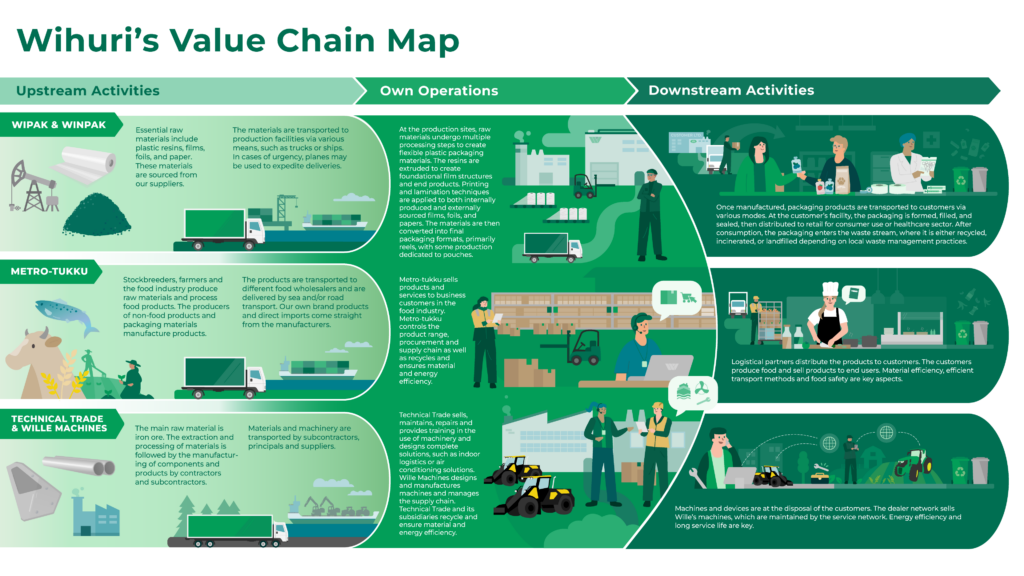
We influence our value chains from primary production to end users. We are committed to respecting internationally recognised human rights as defined in the UN Universal Declaration of Human Rights, the ILO Declaration on Fundamental Principles and Rights at Work, and the UN Guiding Principles on Business and Human Rights.
Our business divisions provide safe products which ensures that our products are safe to use and meet both regulatory requirements and customer expectations. Metro-tukku enables food service operators to serve food made from high‑quality and safe ingredients, contributing to consumer health. Wipak and Winpak manufacture packaging for food, medical and healthcare applications, ensuring product protection, shelf life and sterility.
We mitigate greenhouse gas emissions across the value chain through product innovations. We enable more sustainable choices for our customers. After extensive product development, Wille Machines launched its first fully electric environmental maintenance machine at the end of 2025. This innovation reduces emissions during use and helps customers lower their carbon footprint. In packaging, we reduce emissions related to raw material production by developing packaging solutions that improve recyclability. Emissions are also reduced through solutions where material use has been optimised without compromising protective properties.
We calculate Wihuri Group’s greenhouse gas emissions across the entire value chain.* Our objective is to determine emissions for each business division to establish a Group‑level baseline. We have defined our direct and indirect emissions (Scope 1 and Scope 2) and are in the process of calculating value chain emissions (Scope 3). The majority of Wihuri Group’s emissions arise from Scope 3 categories, meaning that our most significant environmental impacts occur in the value chain, such as primary production, raw material manufacturing and the use phase of machinery.
We use assessments, certifications and third‑party audits as tools to promote sustainability in our value chains. We are implementing EcoVadis assessments for our suppliers. In 2025, the Group conducted a human rights and environmental impact assessment, deepening our understanding of impacts across the entire value chain. Based on this analysis, we develop action plans and strengthen our existing practices, processes and operating models to reduce adverse impacts.
* Winpak and Wipak have previously calculated their carbon footprints and set near‑term emission reduction targets. Winpak’s targets are science‑based and validated by the Science Based Targets initiative (SBTi). Wipak has committed to setting SBTi‑aligned near term targets. SBTi means that companies reduce emissions in line with the 1.5°C target of the Paris Agreement.
Read more about the targets Sustainability | Winpak.